From Turner to bashobits: Admiral Rush and the Art History of Mobility

bashobits, Admiral Rush, from Seasons of Mobility, 2023. Collection of Francisco Carolinum Linz, Linz.
Admiral Rush, from Seasons of Mobility entered the collection of the Francisco Carolinum Linz in January 2026, becoming the first work from Mobility to enter a museum.
This is a perfect fit because Francisco Carolinum Linz is an institution that actively bridges the deep history of the 19th century with the dynamic future of the 21st century.
Founded in 1855 with an educational public mission, the museum has always been an institution designed to move art forward across generations. It keeps extending that time capsule logic into showcasing meaningful art about the future.
Admiral Rush at the Francisco Carolinum Linz also follows a long lineage of vehicle imagery and symbolism, from the 19th century shock of steam and speed, to the modern city’s infrastructure, to the transformation of movement into atmosphere, memory, abstraction, public monuments, and culture, exemplified in works by J.M.W. Turner, Claude Monet, Kobayashi Kiyochika, Mary Cassatt, Edward Hopper, and Ant Farm.
Below is the history of that lineage.
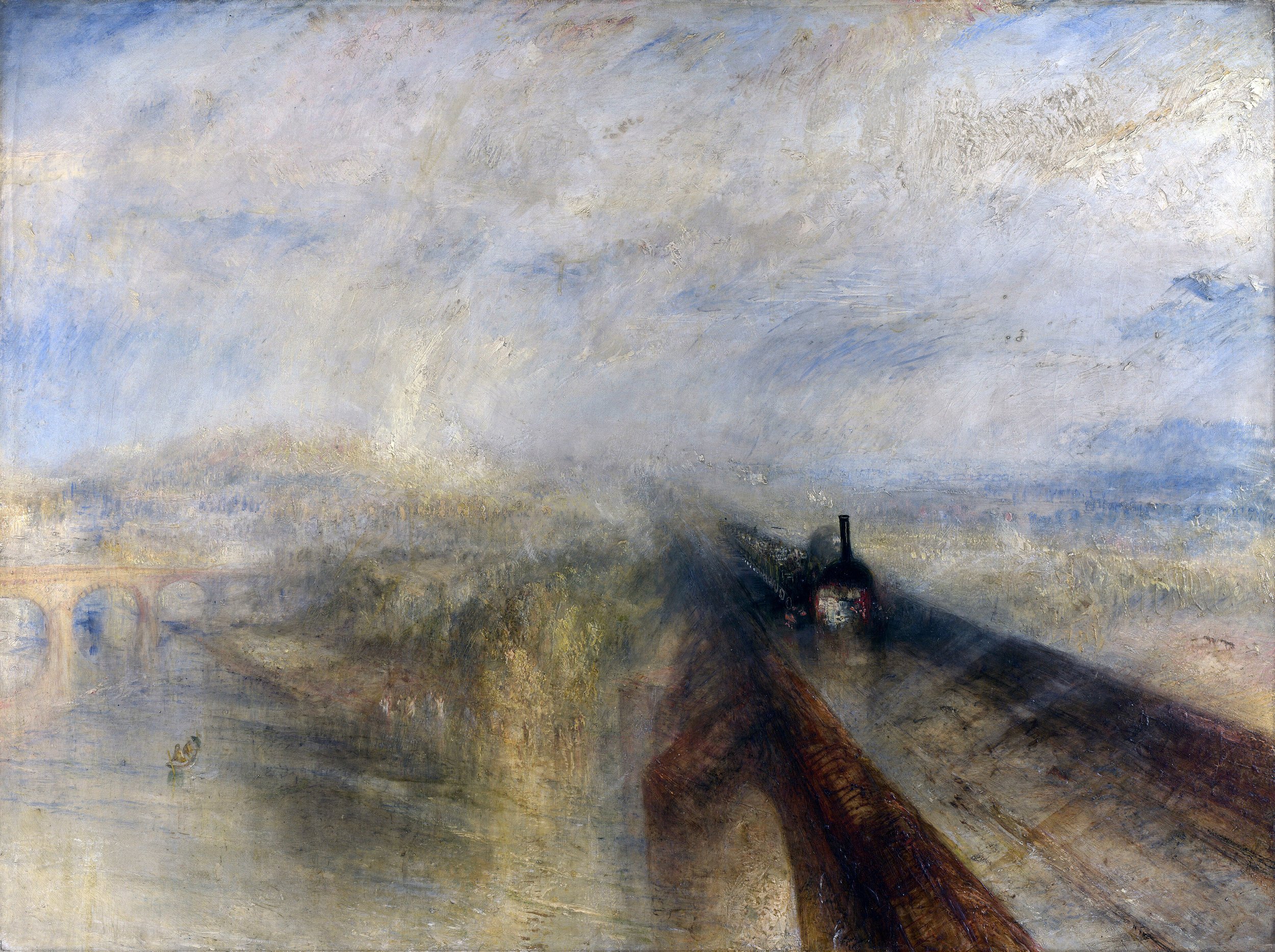
J. M. W. Turner, Rain, Steam and Speed, The Great Western Railway, 1844. National Gallery, London. Image via Wikimedia Commons (Public Domain).
Turner turns the train into a new kind of sublime, a force that compresses weather, landscape, and time into a single, forward surge. Speed becomes the subject and focus. Mobility inherits this iconic “future shock,” treating movement as the core philosophy of an entirely new species.
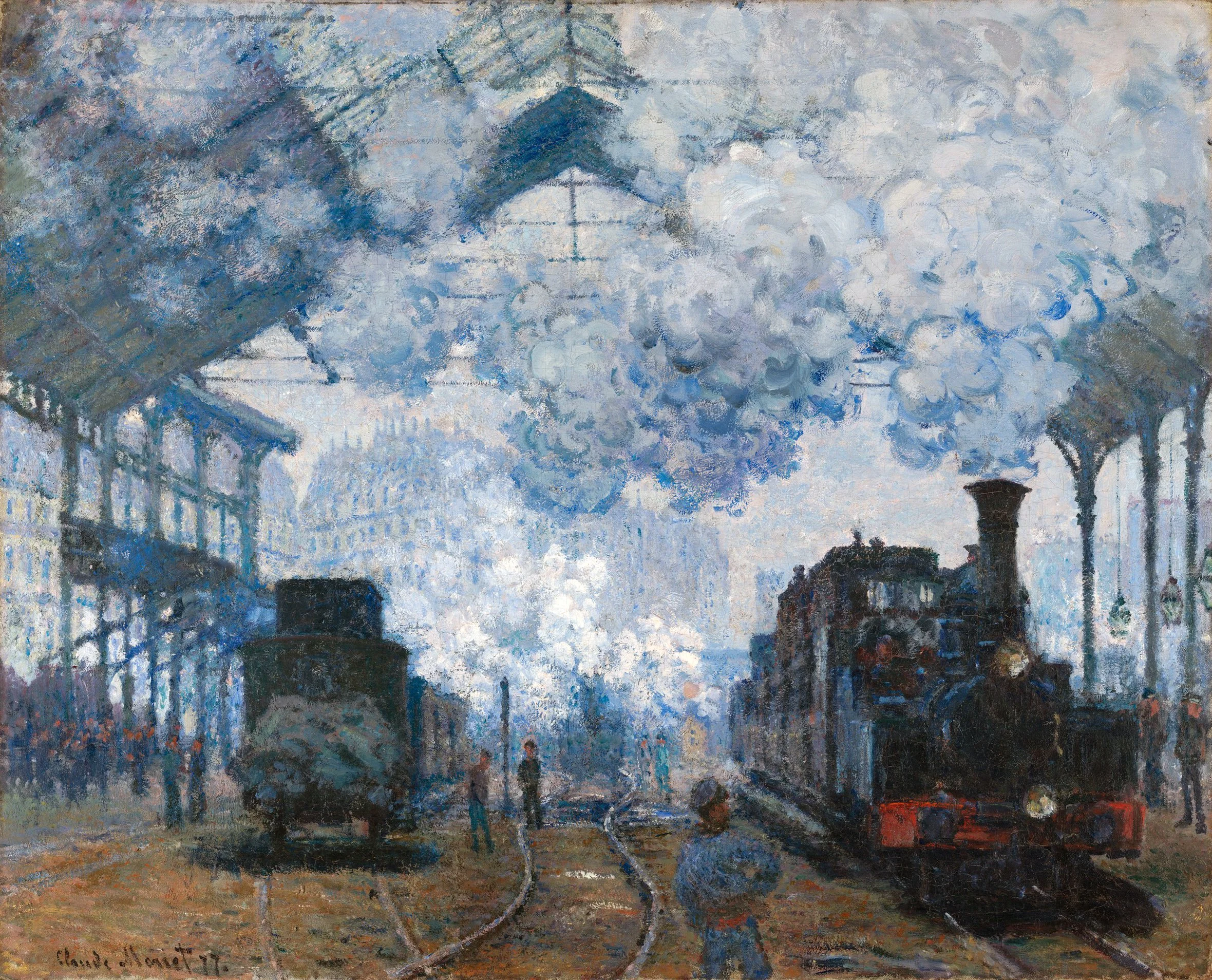
Claude Monet, The Gare Saint-Lazare, Arrival of a Train, 1877. Fogg Art Museum, Cambridge, Massachusetts. Image via Wikimedia Commons (Public Domain).
Monet paints the station as a climate system, with iron, glass, light and especially steam connecting infrastructure to atmosphere. In Seasons of Mobility, that same philosophy expands across the seasons, with autonomous vehicles embedded in nature as a living system of movement and signal.

Kobayashi Kiyochika, View of Takanawa Ushimachi under a Shrouded Moon, 1879. Smithsonian’s National Museum of Asian Art. Image via Wikimedia Commons (Public Domain).
Kiyochika cloaks the steam train in shrouded moonlight, creating a haunting ambiguity. He captures the mixed emotions of a society in transition, where the machine is visualized with both awe and unease. Mobility inherits this complexity, presenting autonomous vehicles through the aesthetic tradition of wabi-sabi, leaving space for the imperfect, the impermanent, and the incomplete.
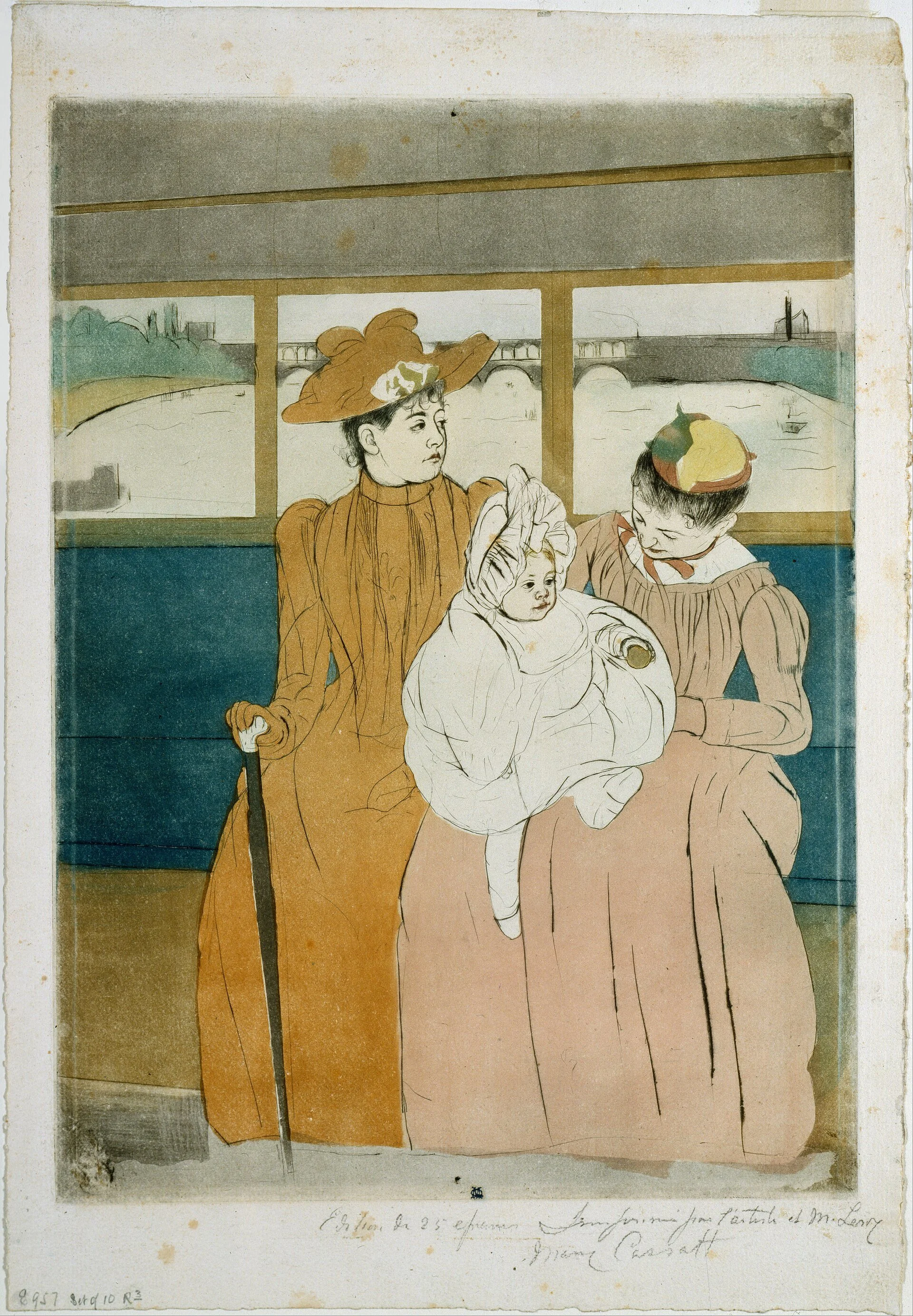
Mary Cassatt, In the Omnibus, 1890–1891. National Gallery of Art, Washington D.C. Image via Wikimedia Commons (Public Domain).
Cassatt depicts public transport as a domestic space in motion, a place where women’s presence and agency in modern life become visible. Mobility retains that spirit of agency, shifting it from the passenger to the vehicle itself possessing autonomous presence.
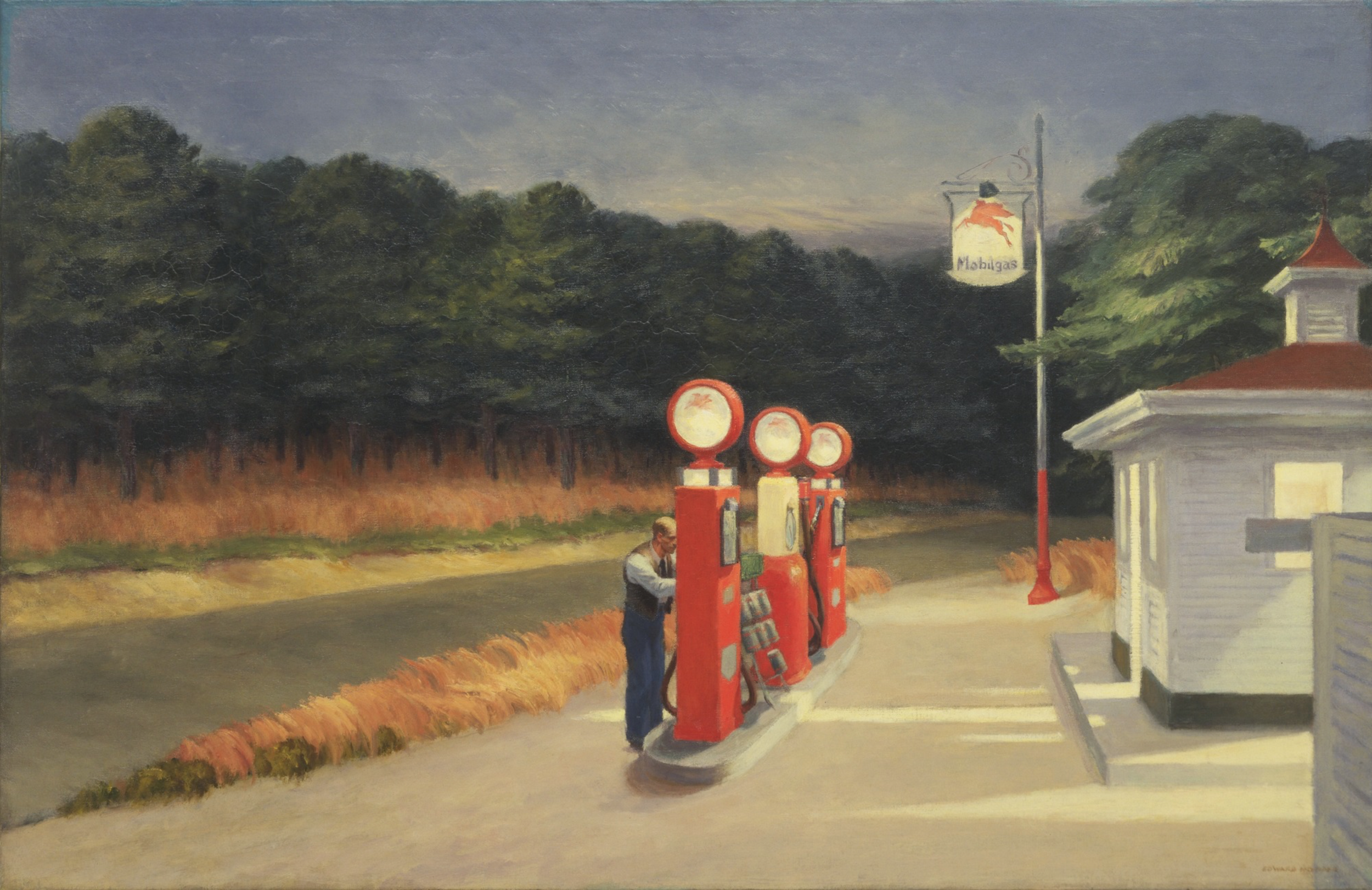
Edward Hopper, Gas, 1940. Museum of Modern Art (MoMA), New York. Image via Wikimedia Commons (Public Domain).
Hopper captures the loneliness of travel infrastructure and emphasizes the silence of the road rather than the speed of the vehicles. Mobility carries that silence forward to the year 1010 AH (After Humanity), when autonomous vehicles persist without passengers and the landscape becomes a meditation on what endures.
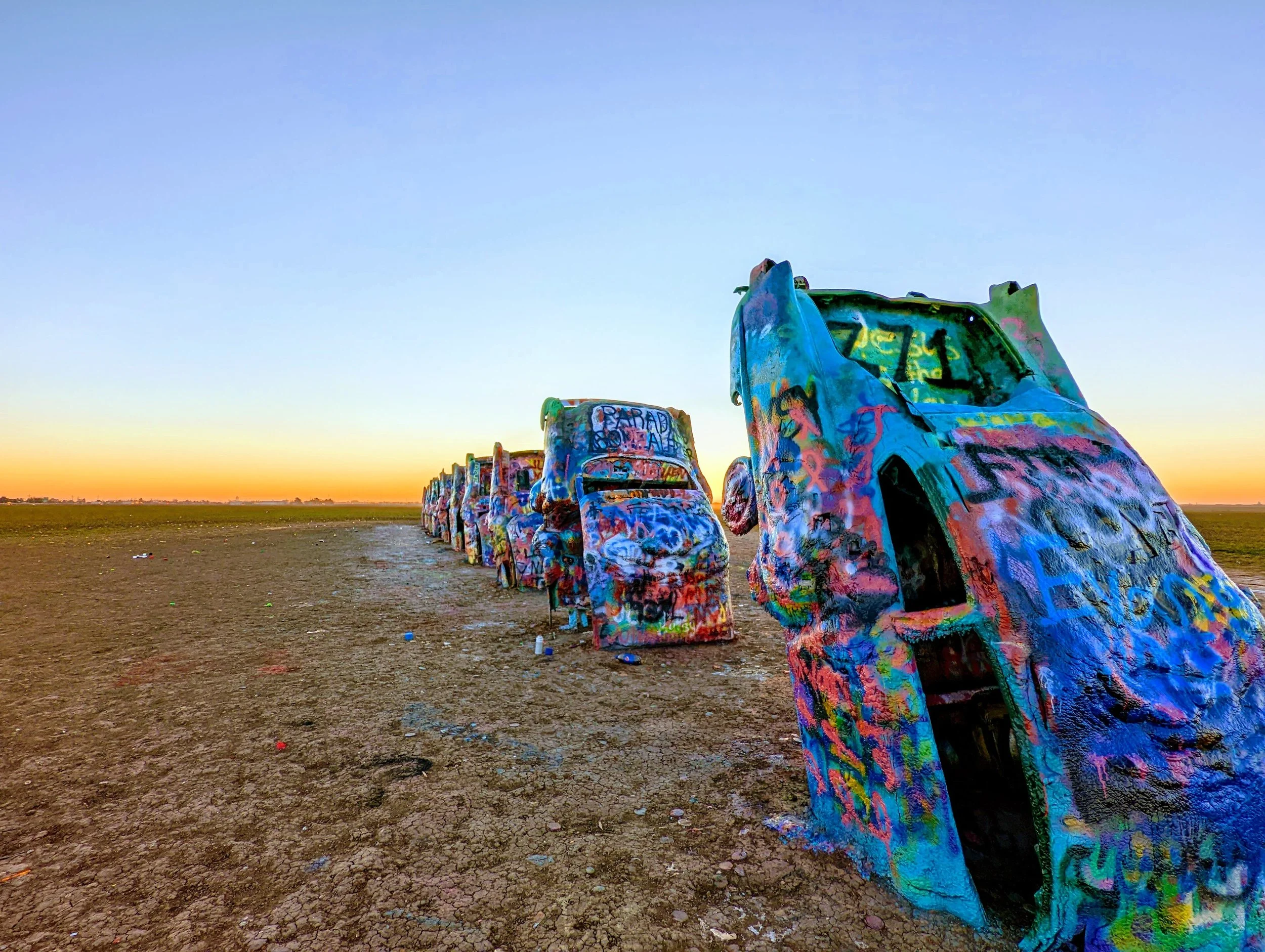
Ant Farm, Cadillac Ranch, 1974, Amarillo, Texas. Image: Thcipriani, CC BY-SA 4.0, via Wikimedia Commons.
Ant Farm invites visitors to participate in a ritual with ten Cadillacs as sculptures buried nose-first in the desert, treating the automobile as a future fossil. Mobility inherits that artistic DNA on a longer horizon, as a species of autonomous vehicles trained on human data and culture, continuing to evolve with the belief that life is motion.
From Turner’s sublime speed to Monet’s atmosphere, from Kiyochika’s nocturne to Cassatt’s moving interior, from Hopper’s roadside hush to Ant Farm’s participatory fossil, mobility has long been a language for how societies feel the future arriving. Admiral Rush enters the Francisco Carolinum Linz as both a continuation of that lineage and as a shift in its centre of gravity. Life is motion.